Showing posts with label Forsythe NWR. Show all posts

Tuesday, April 22, 2014

What I saw on MY Spring Break (Part 7)

And a few odds and ends...

While photographing the Red-tailed Hawk in the parking lot at Forsythe, I turned toward the visitors' center and saw a Wild Turkey heading over to check out the bird feeders for any easily obtained seed that may have been spilled by the smaller songbirds.
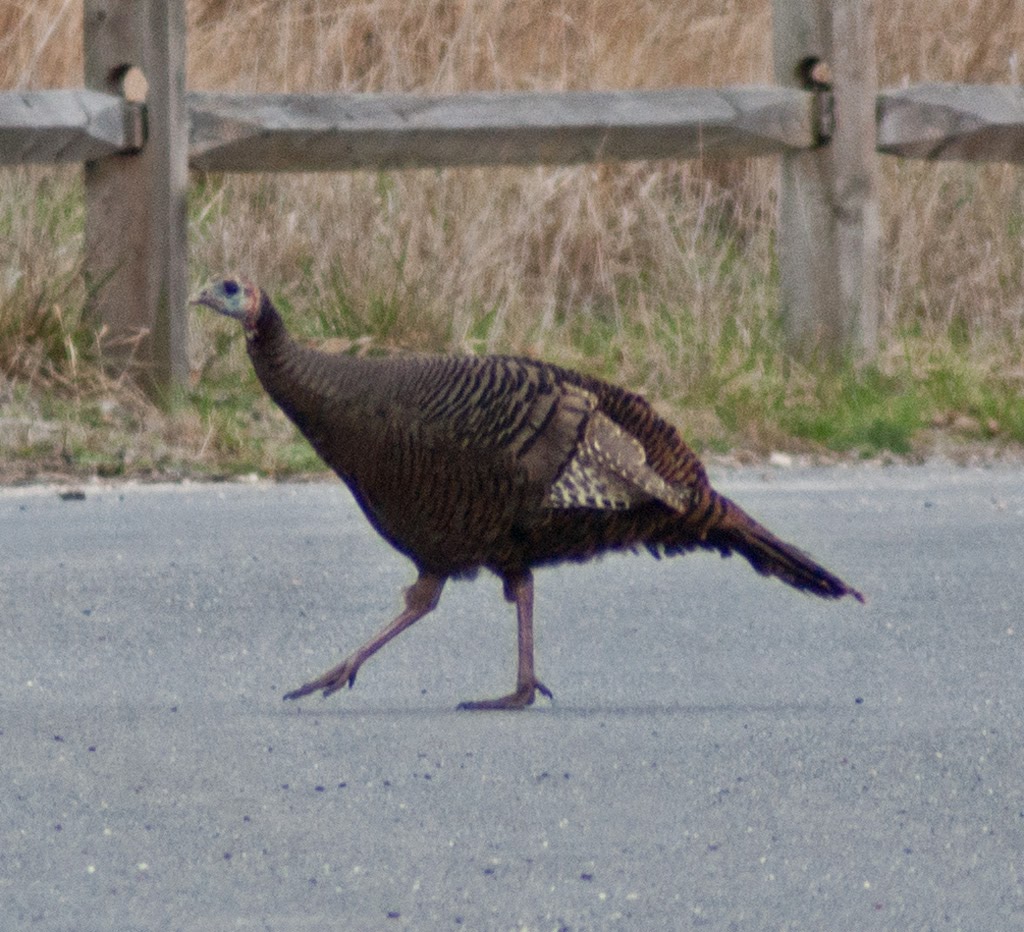
Wild Turkey

And this bird had me puzzled for a bit because those that I thought it might be are usually found high in the tops of trees and not near the ground. Checking All About Birds, however, proved I was correct in calling it a female Scarlet Tanager.

Female Scarlet Tanager

One of their photos of the female is in almost the exact pose as mine! (Just scroll down on this page to Field Marks and select either the male Tanager or the Female Tanager. The photo labeled "4 of 6" is the one to which I refer.)

This ends the series of photos from my trip. I saw lots more birds whose photos I either didn't take or whose photos didn't come out quite as expected. In total I had approximately 75 species from Tuesday afternoon through Friday evening without looking for things like owls or rails or nighthawks.

There may have been a few birds I saw that I didn't/couldn't identify. For example, I'm not sure if that was a Chimney swift I saw with the Purple Martins, Barn Swallows and Tree Swallows over the ponds at the Lighthouse, but it sure looked like a flying cigar! And those black and white birds that took off as I topped the dunes at the Lighthouse SP...were they Black Skimmers looking for a nest site? All in all I think I did alright. Certainly the species count was not too shabby, in my opinion.

What I saw on MY Spring Break (Part 6)

Then there were wading birds (besides the egrets). A lot of the shore birds were still to the south awaiting the spawning of the horseshoe crabs, but there were a few that were either year-round residents or just early arrivals.

One morning at Forsythe I found a group of Glossy Ibises feeding in the ditch along side the road.

Glossy Ibis

Glossy Ibis

Glossy Ibis

The mud flats played host to numerous Greater Yellowlegs with their spotted breasts and long yellow legs and bill.

Greater Yellowlegs

Greater Yellowlegs

Greater Yellowlegs

Greater Yellowlegs

The rocks and edges of the flats held several pairs of Oystercatchers.

Oystercatcher

Oystercatcher

As the week went on there were several early arrivals in the form of Dunlin. Whirling flocks of these small birds could be seen on the flats. Their shorter legs and slightly down-curved bills helped to identify them.

Dunlin

One morning at Sunset Beach I saw this small bird hoist itself onto the rock jetty just above the breaking waves. It looked and acted exhausted. Not being in its breeding plumage yet, it puzzled me but based upon its size and short bill, I figured it was a Ruddy Turnstone. It was early to the feast but it will be joined by thousands of its relatives as well as Semi-palmated Plovers in a few weeks...if it lives that long.
Ruddy Turnstone

I did see a half a dozen Willets at Reed's Beach, but it was the one time I left the camera in the Tundra. DOH!

What I saw on MY Spring Break (Part 5)

Water fowl. Lots of water fowl. Some of these will be present in the interior but quite a few are coastal or migratory only. Ducks, swans, geese, brant...quite the variety.

Mute Swans, considered by many to be an invasive species in need of eradication, were present in fairly large numbers. Almost every pond had at least one pair of these large birds. They make quite the racket when taking off and landing. I'm not sure if it's their wings or the slapping of their feet on the water but it's loud!

Mute Swan

I was surprised to find this solitary Snow Goose still on the salt marsh in Forsythe...until I noticed it had a broken wing and was unable to fly. Then I was surprised that it hadn't been preyed upon by either the Perigrine Falcon, raccoon or fox.

Snow Goose

The Brant is a small goose that looks a lot like a Canada Goose (which I didn NOT photograph!) but lacks the white chin patch of the Canada and is about 2/3 the size. It feeds on the salt marsh grasses along the coast and nests way up north on the Arctic and Hudson Bay coast. The hundreds I saw were probably waiting for warmer weather or a good southern tail wind to head north.

Brant

Double-crested Cormorants were in abundance on the cape. Low in the water these birds dive fro their dinner.

Double-crested Cormorant

As to why they are called "Double-crested", this shot should provide the reason.

Double crests on display.

They also like to hang out in large groups like this one on the concrete ship--the S.S. Atlantus-- at Sunset Beach. Rock jetty's and groins or even turf spits on the flats are also likely hang outs.

Cormorants on the Concrete Ship

Also swimming about the waters of the Delaware Bay were hundreds of Western Grebes. Most were fishing out on the shoals beyond the Concrete Ship, but a few were in closer to the beach. Not being in their mating plumage yet, they were rather drab looking. The black and white will be more distinct in a couple of weeks.

Western Grebe

I also witnessed a small flight of Northern Gannets over Delaware Bay. Alas they were too far out to get any pictures.

One of the ducks that will be found inland as well as along the coastal mud flats is the colorful Northern Shoveler. The huge, broad beak explains it's name.

Northern Shoveler

The Green-winged Teal is another duck that can be found inland. Sometimes folks may confuse it with the Wood Duck because of its red and green head markings. The dark beak (as opposed to orange in the Wood Duck) and the gray flanks with just a bit of cream on the hips (vs. a nearly solid cream flank of the Wood Duck) should help distinguish the two. (I did see one pair of Wood Duck on a nesting box at Forsythe but they were w-a-y out there.)

Green-winged Teal

While not a duck, I did see one American Coot paddling among the reeds in one of the pools at the Lighthouse SP.

American Coot


Then there was this oddity which I believe to be a hybrid cross between a Mallard and Black Duck.

Hybrid Mallard-x-Black Duck

What I saw on MY Spring Break (Part 4)

Raptors and Ospreys. A few of the former (all Red-tailed Hawks) and lots of the latter in all the right places. (Right places being at Forsythe NWR, Cape May Lighthouse SP, The Migratory Bird Refuge (a Nature Conservancy project next door to the Lighthouse SP) and everywhere in between. If they put up a nesting pole, it was occupied.)

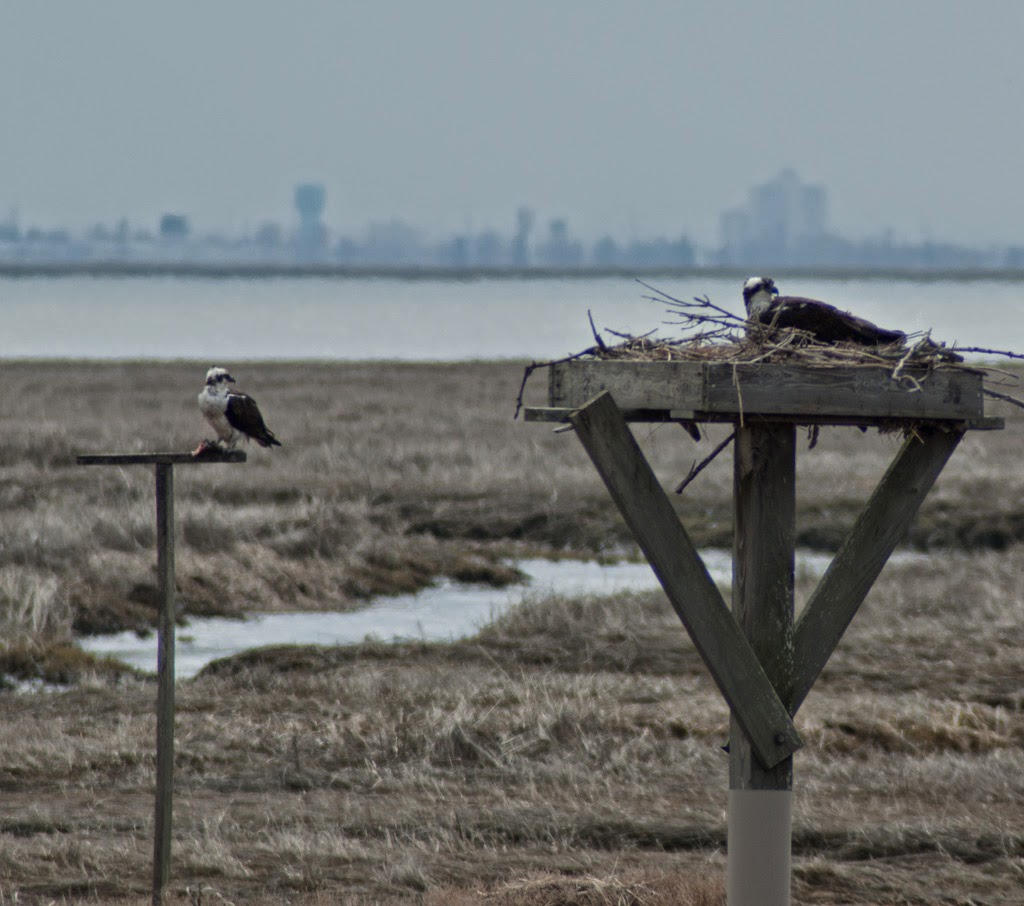
I got to see dozens of Ospreys on their nests, mating, hunting, fighting off Herring Gulls--or one another. Hard to believe there were only sixty mating pairs in New Jersey in 1970.

Osprey on the hunt.

Osprey on the hunt.

Osprey on the hunt.

Success!

One of many, many mated pairs at Forsythe NWR.

Ospreys are not uncommon here in the Northern Tier. Hammond, Tioga and Cowanesque Lakes--all Corps of Engineers' flood control projects--are home to mating pairs every summer. Hills Creek SP and other locations around Tioga Co. also play host to Osprey pairs.

Red-tailed Hawks are also common in Tioga Co.--and much of the eastern US. But there were a couple of immatures that seemed attracted to the camera. Especially one that hung around the Forsythe headquarters and the start of the dike loop.

This bird seemed totally at easy with folks gathering below to snap its photo. Or even rolling slowly past the speed limit sign upon which it perched.

Red-tailed Hawk (imm) in the parking lot at Forsythe.

Red-tailed Hawk (imm) on the speed limit sign 
at the start of the 8-mile loop.


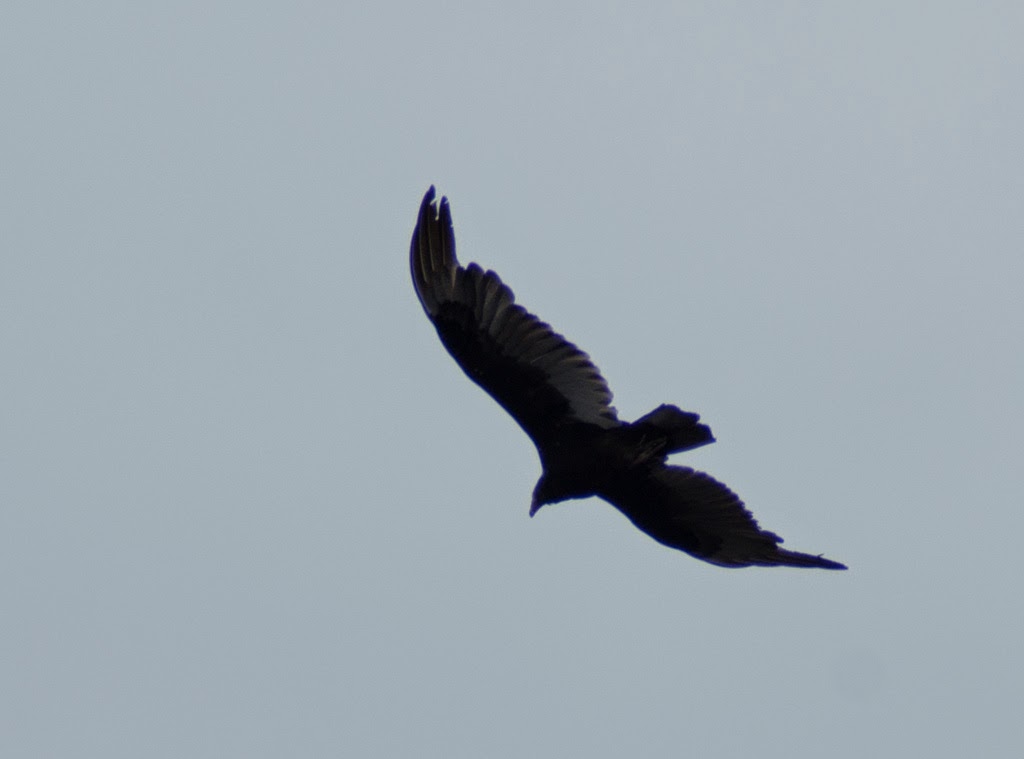
While not exactly a raptor or bird of prey, there were hundreds of Vultures streaming northward.One morning, while visiting Sunset Beach at the tip of Cape May, I saw them coming from Delaware by the dozens. In just half an hour there must have been 75 that passed over head.

Some of them may have been Black Vultures, but I was too lazy to check them all out. The one in the photo below is clearly a Turkey Vulture as seen by the light area under each wing.

Turkey Vulture

What I saw on MY Spring Break (Part 3)

Of course there were gulls and terns:

Herring Gull

I had to be on the constant watch as I drove the dikes at Forsythe. One of these guys could have dropped a clam or mussel on the Tundra at any time. Often they would try this trick just yards ahead of me. If they left the shellfish on the road as I approached, I tried to run over it and break the shell for them. And not one "Thank you" came my way!

Great Black-backed Gull

Less common than the Herring Gull, these guys look like CEOs in comparison. (Sorry about the slightly fuzzy photo. It was a long shot and I must have focused on something near but not quite the gull.)

Laughing Gull

The Laughing Gull can occasionally be spotted inland but its look-alike the Bonaparte's Gull is more frequently seen here in Tioga Co. (The difference is in the color of the bill. LG has a red one, BG has a black bill.)

Common Tern

I'm calling this a Common Tern although it could be a Roseate or Forster's. The lighting isn't the greatest and the color of the bill, forking of the tail, etc. aren't shown to the best advantage. To distinguish the three apart form one another is a real challenge. But, the Common IS more common than the others. It and the Forster's Tern sometimes visits Tioga CO.

The slightly darker (to my eye) back also indicates it may be a Common Tern.

Common Tern

What I saw on MY Spring Break, (Part I)

Last week I spent four days in the vicinity of the Cape May Lighthouse.

Cape May Lighthouse

And, no, I did not climb the 199 stairs to get a view from the top. I'm sometimes stupid, but I'm not crazy.

Actually, I ranged from Sunset Beach at the (nearly) southernmost tip of the Cape up to Smithville and Leeds Point to the north and from the Atlantic shore to the Delaware Bay. Roughly 45 miles south to north and slightly less east to west.

My goal was to view birds...and, maybe, get some good, fresh seafood meals! Mission accomplished on both fronts. The food at the Oyster Creek Inn and the Smithville Inn was excellent and the service top notch. The birds, while not yet at their peak, the horseshoe crabs hadn't returned to the bay beaches to lay their eggs and attract hordes of shorebirds, and the warblers hadn't yet decided if winter had, indeed, retreated far enough north to make their search for insects a successful one so they were hanging back. Still, Mother Nature presented nearly 75 different species for my viewing pleasure.

Some of the birds were common to north-central PA (Song Sparrow, Robin, Northern Cardinal, Red-winged Blackbird, Mourning Dove, Red-tailed Hawk, etc.) But some of them presented themselves out in the open where a photo could be easily taken.

Other species will never be seen--or, at least, will seldom be seen--in my home territory being indigenous to the salt marsh and seashore environment.

Let me show you a few:

Snowy Egret

Snowy Egret
The bird above may look a little bashful, but he probably has some small critters up against the reeds and is waiting to pounce.

Great Egret
Next to the Mute Swans, this was probably the largets bird I encountered. Half again as large as the Snowy Egret without the feathery plumes, the extremely long neck, totally black legs and bright orange bill will help differentiate them. (The snowy has a shorter neck, black bill and bright orange feet at the end of its black legs.)

Great Egret

Wednesday was a breezy one at the Edwin B, Forsythe National Wildlife Refuge, so lots of birds were tucked into protective little corners that served as windbreaks. This cluster looked more like a small class outing with the teacher (the Great Egret on the right) instructing the pupils (the four Snowy Egrets on the left).

Mixed Group of Snowy and Great Egrets


I've lots more where these came from!