Tuesday, April 22, 2014

What I saw on MY Spring Break (Part 5)

Water fowl. Lots of water fowl. Some of these will be present in the interior but quite a few are coastal or migratory only. Ducks, swans, geese, brant...quite the variety.

Mute Swans, considered by many to be an invasive species in need of eradication, were present in fairly large numbers. Almost every pond had at least one pair of these large birds. They make quite the racket when taking off and landing. I'm not sure if it's their wings or the slapping of their feet on the water but it's loud!

Mute Swan

I was surprised to find this solitary Snow Goose still on the salt marsh in Forsythe...until I noticed it had a broken wing and was unable to fly. Then I was surprised that it hadn't been preyed upon by either the Perigrine Falcon, raccoon or fox.

Snow Goose

The Brant is a small goose that looks a lot like a Canada Goose (which I didn NOT photograph!) but lacks the white chin patch of the Canada and is about 2/3 the size. It feeds on the salt marsh grasses along the coast and nests way up north on the Arctic and Hudson Bay coast. The hundreds I saw were probably waiting for warmer weather or a good southern tail wind to head north.

Brant

Double-crested Cormorants were in abundance on the cape. Low in the water these birds dive fro their dinner.

Double-crested Cormorant

As to why they are called "Double-crested", this shot should provide the reason.

Double crests on display.

They also like to hang out in large groups like this one on the concrete ship--the S.S. Atlantus-- at Sunset Beach. Rock jetty's and groins or even turf spits on the flats are also likely hang outs.

Cormorants on the Concrete Ship

Also swimming about the waters of the Delaware Bay were hundreds of Western Grebes. Most were fishing out on the shoals beyond the Concrete Ship, but a few were in closer to the beach. Not being in their mating plumage yet, they were rather drab looking. The black and white will be more distinct in a couple of weeks.

Western Grebe

I also witnessed a small flight of Northern Gannets over Delaware Bay. Alas they were too far out to get any pictures.

One of the ducks that will be found inland as well as along the coastal mud flats is the colorful Northern Shoveler. The huge, broad beak explains it's name.

Northern Shoveler

The Green-winged Teal is another duck that can be found inland. Sometimes folks may confuse it with the Wood Duck because of its red and green head markings. The dark beak (as opposed to orange in the Wood Duck) and the gray flanks with just a bit of cream on the hips (vs. a nearly solid cream flank of the Wood Duck) should help distinguish the two. (I did see one pair of Wood Duck on a nesting box at Forsythe but they were w-a-y out there.)

Green-winged Teal

While not a duck, I did see one American Coot paddling among the reeds in one of the pools at the Lighthouse SP.

American Coot


Then there was this oddity which I believe to be a hybrid cross between a Mallard and Black Duck.

Hybrid Mallard-x-Black Duck

What I saw on MY Spring Break (Part 4)

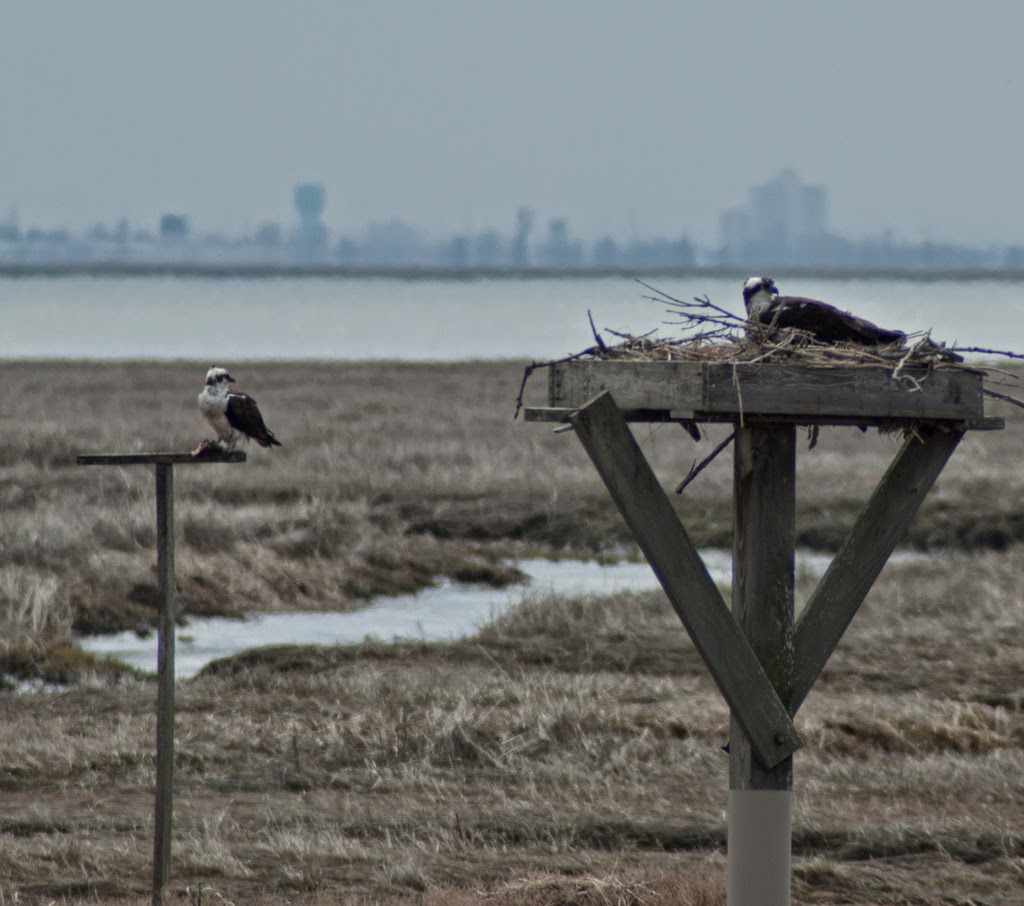
Raptors and Ospreys. A few of the former (all Red-tailed Hawks) and lots of the latter in all the right places. (Right places being at Forsythe NWR, Cape May Lighthouse SP, The Migratory Bird Refuge (a Nature Conservancy project next door to the Lighthouse SP) and everywhere in between. If they put up a nesting pole, it was occupied.)

I got to see dozens of Ospreys on their nests, mating, hunting, fighting off Herring Gulls--or one another. Hard to believe there were only sixty mating pairs in New Jersey in 1970.

Osprey on the hunt.

Osprey on the hunt.

Osprey on the hunt.

Success!

One of many, many mated pairs at Forsythe NWR.

Ospreys are not uncommon here in the Northern Tier. Hammond, Tioga and Cowanesque Lakes--all Corps of Engineers' flood control projects--are home to mating pairs every summer. Hills Creek SP and other locations around Tioga Co. also play host to Osprey pairs.

Red-tailed Hawks are also common in Tioga Co.--and much of the eastern US. But there were a couple of immatures that seemed attracted to the camera. Especially one that hung around the Forsythe headquarters and the start of the dike loop.

This bird seemed totally at easy with folks gathering below to snap its photo. Or even rolling slowly past the speed limit sign upon which it perched.

Red-tailed Hawk (imm) in the parking lot at Forsythe.

Red-tailed Hawk (imm) on the speed limit sign 
at the start of the 8-mile loop.


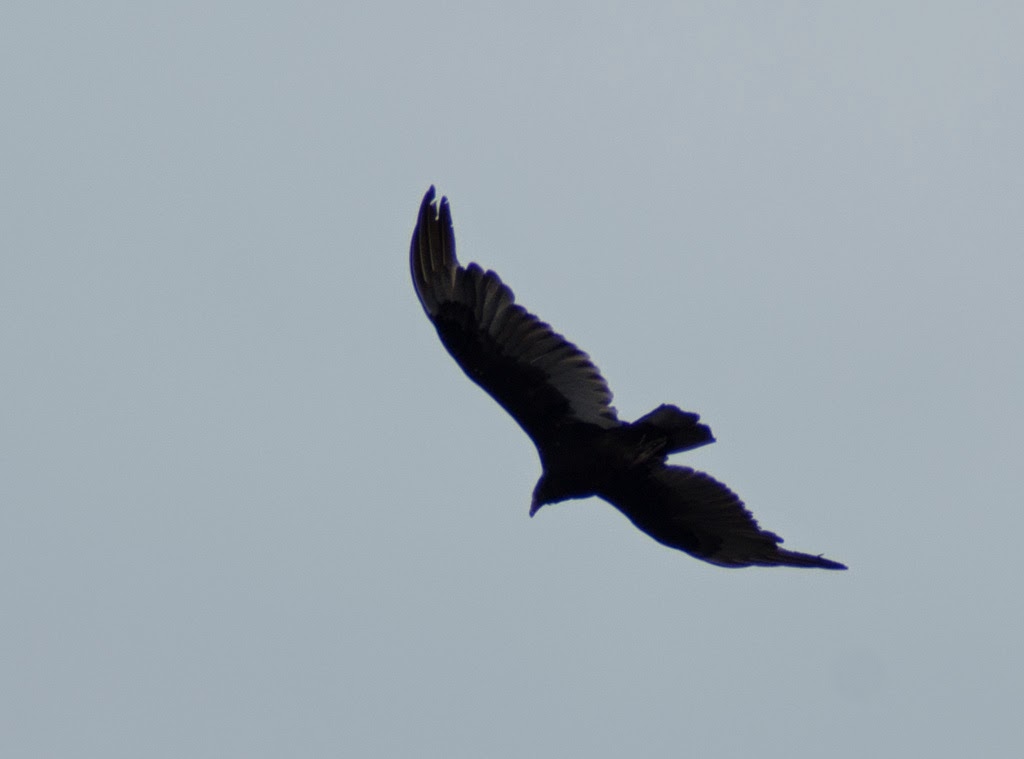
While not exactly a raptor or bird of prey, there were hundreds of Vultures streaming northward.One morning, while visiting Sunset Beach at the tip of Cape May, I saw them coming from Delaware by the dozens. In just half an hour there must have been 75 that passed over head.

Some of them may have been Black Vultures, but I was too lazy to check them all out. The one in the photo below is clearly a Turkey Vulture as seen by the light area under each wing.

Turkey Vulture

What I saw on MY Spring Break (Part 3)

Of course there were gulls and terns:

Herring Gull

I had to be on the constant watch as I drove the dikes at Forsythe. One of these guys could have dropped a clam or mussel on the Tundra at any time. Often they would try this trick just yards ahead of me. If they left the shellfish on the road as I approached, I tried to run over it and break the shell for them. And not one "Thank you" came my way!

Great Black-backed Gull

Less common than the Herring Gull, these guys look like CEOs in comparison. (Sorry about the slightly fuzzy photo. It was a long shot and I must have focused on something near but not quite the gull.)

Laughing Gull

The Laughing Gull can occasionally be spotted inland but its look-alike the Bonaparte's Gull is more frequently seen here in Tioga Co. (The difference is in the color of the bill. LG has a red one, BG has a black bill.)

Common Tern

I'm calling this a Common Tern although it could be a Roseate or Forster's. The lighting isn't the greatest and the color of the bill, forking of the tail, etc. aren't shown to the best advantage. To distinguish the three apart form one another is a real challenge. But, the Common IS more common than the others. It and the Forster's Tern sometimes visits Tioga CO.

The slightly darker (to my eye) back also indicates it may be a Common Tern.

Common Tern

What I saw on MY Spring Break, (Part 2)

In addition to the egrets there were some birds that I could be seen in almost every environment along the coastal ponds or upland environment.

Some were species I would expect to see in Tioga County, PA. Birds like the Mourning Dove, Mockingbird, Robin, Starling, and those noisy, territorial birds posing below:

Brown Thrasher

Red-winged Blackbird

Song Sparrow

What I saw on MY Spring Break, (Part I)

Last week I spent four days in the vicinity of the Cape May Lighthouse.

Cape May Lighthouse

And, no, I did not climb the 199 stairs to get a view from the top. I'm sometimes stupid, but I'm not crazy.

Actually, I ranged from Sunset Beach at the (nearly) southernmost tip of the Cape up to Smithville and Leeds Point to the north and from the Atlantic shore to the Delaware Bay. Roughly 45 miles south to north and slightly less east to west.

My goal was to view birds...and, maybe, get some good, fresh seafood meals! Mission accomplished on both fronts. The food at the Oyster Creek Inn and the Smithville Inn was excellent and the service top notch. The birds, while not yet at their peak, the horseshoe crabs hadn't returned to the bay beaches to lay their eggs and attract hordes of shorebirds, and the warblers hadn't yet decided if winter had, indeed, retreated far enough north to make their search for insects a successful one so they were hanging back. Still, Mother Nature presented nearly 75 different species for my viewing pleasure.

Some of the birds were common to north-central PA (Song Sparrow, Robin, Northern Cardinal, Red-winged Blackbird, Mourning Dove, Red-tailed Hawk, etc.) But some of them presented themselves out in the open where a photo could be easily taken.

Other species will never be seen--or, at least, will seldom be seen--in my home territory being indigenous to the salt marsh and seashore environment.

Let me show you a few:

Snowy Egret

Snowy Egret
The bird above may look a little bashful, but he probably has some small critters up against the reeds and is waiting to pounce.

Great Egret
Next to the Mute Swans, this was probably the largets bird I encountered. Half again as large as the Snowy Egret without the feathery plumes, the extremely long neck, totally black legs and bright orange bill will help differentiate them. (The snowy has a shorter neck, black bill and bright orange feet at the end of its black legs.)

Great Egret

Wednesday was a breezy one at the Edwin B, Forsythe National Wildlife Refuge, so lots of birds were tucked into protective little corners that served as windbreaks. This cluster looked more like a small class outing with the teacher (the Great Egret on the right) instructing the pupils (the four Snowy Egrets on the left).

Mixed Group of Snowy and Great Egrets


I've lots more where these came from!

Tuesday, April 15, 2014

Birding in South New Jersey: Arrival

I drove to Cape May this morning. In the rain. Near zero visibility in the splash of some semis as they went by or as I past them on the hills. It was like driving 60-65 mph through a car wash. At least the mud is now officially off the truck!

Six hours and 300 miles after leaving the Aerie, I checked into the Hyland Motor Inn in Cape May Court House at exactly 2:00 PM. I only had to scold SIRI twice for giving me questionable directions. (Why was I supposed to go NORTH on I-81 towards Wilkes Barre to get to the Penn Pike when continuing east on I-80 gets me to the same highway without the two-legs-(or more)-of-the-triangle approach? Did I have to sneak up on the Turnpike?)

As I drove south on the GSP from the Atlantic City Expressway, I was struck by the thought that it's been more than twelve (12) years since I was this far south in New Jersey. It's been ten (10) years since I retired from Parsippany. It's been eight (8) years since we started construction on the Aerie. Seven-and-a-half since we moved out of Morristown!

They seem to be reconstructing every north-south road in Atlantic and Cape May counties. The GSP is getting extra lanes and the old Rout 9 bridge over Egg Harbor is ripped up. Those two projects make me glad I'm here now before the summer mop starts to show up. Only bad thing about being ahead of the crowd is that many of the restaurants aren't open yet. Some have signs saying weekends only others say May 1st and others aren't saying much of anything.

The room is small, but it's relatively cheap, oh so quiet and right off the Garden State Parkway. I'm still about 20 miles north of Cape May lighthouse, 30 or so miles south of Oceanville and Forsythe NWR and directly inland from Stone Harbor.

After checking in, I drove down to the visitors' center in Cape May where I spoke with Vince who gave me a county map, a town map and a very nice booklet called "New Jersey Birding & Wildlife Trails: Delaware Bayshore." After telling him it had been a loooooong time since I had visited the Cape, Vince also took time to point out where things were south of the Canal.

So, chock full of information, I headed on down toward the western tip of the Cape. I made one stop at Sunset Beach to say hello to The Concrete Ship and another to the Lighthouse and Hawk Watch area in the parking lot. I did a little birding at each stop before rain/drizzle forced me to concede the field. I drove up toward Higbee Beach on the southwest end of the Canal just to get my bearings. It was raining too hard to stop there, however.

The rain that I experienced all day--very heavy at times--is supposed to head out to sea tonight and the next couple of days will be slightly cooler but clear. With luck, I'll be up at Forsythe NWR bright and early tomorrow.

Thursday, April 10, 2014

Birding Photos from April 3rd

So last Thursday was my second consecutive day of birding in Tioga County, PA. As I had on the previous day, I visited three sites that are usually very productive and, while they weren't chock full of the small birds (warblers and such) that will be present in a couple of weeks, I got in some walking, had a good time and came away with some decent photos just the same.

My first stop was at The Muck on Route 287 just west of Wellsboro. The Boardwalk and blind overlook some marshy areas and a bit of open water. It was a bit blustery and cold, but most of the ice was out of the ponds nearest the blind. Unfortunately, the few birds that were present were on the far end of the water and/or tucked into the marsh grasses.

Pair of Hooded Mergansers at The Muck. 

Mallard at The Muck.

After half an hour of blowing on my fingers, I headed down the road a short distance and walked the Pine Creek Rails-to-Trails Bike Path's northern terminus. I found much less wind here and a horde of Red-winged Blackbirds right at the parking lot. Mallards, Canada Geese, Wood Ducks and Killdeer flushed from puddles and Marsh Creek to fly overhead. I also spotted one Belted Kingfisher from an unphotographable distance. Further down there were dozens of Song Sparrows feeding on the verge of the trail. The sparrows blended in with the golden brown of the grass and, even when moving off into the shrubs, were in constant motion. Still there were a few birds that posed long enough for me to get their photos.

Cardinal sitting and singing in the sun.

After going about 3/4 of a mile down the trail, I turned to walk back to the truck and immediately spotted two groups of Downy Woodpeckers working either side of the trail. Each group consisted of one male and two females. I draw no conclusions from this, however.

Male Downy Woodpecker.

Female Downy Woodpecker.

I was watched carefully by an Eastern Chipmunk sunning him/herself on a concrete block along the side of the trail.

Eastern Chipmunk

Getting back into the Tundra I headed west to Darling Run and another favorite section of the Pine Creek Rails-to-Trails path. I was greeted by an Eastern Phoebe in the parking lot and, as I walked down to the trail, a mature Bald Eagle. There wasn't a lot of activity on Pine Creek, just a few Common Mergansers, Canada Geese and one Great Blue Heron who stayed just out of range ahead of me, but there were Song Sparrows perched on every other shrub and each was singing its little heart out. The highlights of this stop--besides the Bald Eagle who indicated that the nest on the other side of Pine Creek is in use--were a Pileated Woodpecker who was excavating an old hole on the far side of the creek, and a Brown Creeper.

Song Sparrow showing its stripped, rusty cap

Song Sparrow's dotted chest

Bald Eagle along the trail at Darling Run

Brown Creeper.

The Eagle let me walk (almost) underneath him--twice--and seemed totally unconcerned about my presence. The Creeper was singing a little, repetitive,high-pitched, one-note song that I couldn't ID (sounded a bit like a Dark-eyed Junco's trill only an octave higher) and that caused me to pause and actually look for him. Even then, it was only when I spotted a chunk of "bark" moving up the tree 10 feet in front of me that I saw the little bird.

Not a bad day out and about, but the three or four miles I walked--added to the next Saturday's 1.5-2 miles at Hills Creek SP--may have been a bit too much for my knees. *sigh*

Wednesday, April 09, 2014

Birding Last Wednesday, April 2nd

The first week in April I started making the rounds to various birding sites in Tioga County, PA. I managed to visit three sites a day for two days just to see what might be here. I probably was too late for some species that had flown through (Snow Geese, for instance) but there was still hope of catching some of the water fowl on lakes that were just starting to loose their ice cover.

My first stop on Wednesday, April 2nd, was at the Hammond-Tioga Lakes overlook in Tioga, PA. Hammond Lake was still heavily iced up but there was some open water on both sides of the connecting weir. As I stood at the overlook, I saw numerous immature and mature Bald Eagles flying overhead but getting a good photo of them was nearly impossible. There were a few Common Mergansers, Horned Grebes, Canada Geese and Ring-necked Ducks on the water far below, but, again, the 300mm lens just wasn't enough.

One bird that I was pleased to see, was an Osprey. It was perched on the nesting pole along the drive up to the overlook. I managed to get a couple of decent pictures from the road. While I was at the overlook, two of these birds flew overhead, so it's likely they will be breeding on that pole this spring.

Osprey on nesting pole.


From the overlook, I drove to the west end of Hammond Lake and the Ive's Run day use area where Crooked Creek flows into the lake. The ice was pushed back a bit and the creek was completely clear of ice. Dozens of Red-Winged Blackbirds, Canada Geese and Mallards were taking advantage of the open, but quite high water. All the Mallards flushed and left for more distant waters before I could get a photo. The Geese and Red-wings stuck around to scold the hell out of me.


Canada Geese on Crooked Creek

Red-winged Blackbird lets me know it is not pleased with my presence.

The grassy areas around the parking lot played host to Grackles and Robins searching for worms and the shrubs served as perches to Song Sparrows which seemed to be every 10 feet or so apart. The large rock near the boat ramp provided a warm place fr a pair of Killdeer to do their courting.

Killdeer at the Ive's Run day use area.

Hopefully they will find a more level site on which to lay their eggs.

My final stop of the day was at Hills Creek State Park. The Audubon Society bird walks were to begin on Saturday the fifth and I wanted to do a little scouting. The entire northeast side of the lake (viewed from the beach area) was still ice covered but there was a sizable open area in front of the beach and around to the southwest. And there were quite a few different species of water fowl taking advantage of that open water.

There were Mallards and Ring-necked Ducks...

Male Mallard and both male and female Ring-necked Ducks.

Male and female Ring-necked Ducks. The ring on the bill is easier to spot 
than the "ring" (actually more a dirty collar) on the neck.

...many Horned Grebes with the males sporting their yellow-gold sideburns...

Horned Grebes.

...Canada Geese and Red-necked Grebes.
Canada Goose and three Red-necked Grebes.

I had some trouble IDing the grebes because, well, their necks just didn't seem red enough. But, unbeknownst to me at the time, a couple of birding friends were out that same day on the other side of the lake nearer to these birds and they said they were Red-necked Grebes. Upon reviewing the photographic evidence--their's and mine--I could see that we were looking at the same birds and that they were, indeed, Red-necked Grebes.

eBird will tell you that the Red-necked Grebe is an unusual sighting for this particular place and/or time but talking things over with my friends they say they appear in this area almost every year as they migrate northward. I suppose they follow the Chesapeake Bay to its northern end and then cut north heading for either Lake Ontario, the St. Lawrence or points north.

With that Hills Creek SP stop I ended my morning and headed home to do some chores. I did, however plan to do more birding the next day. The photos from Thursday's outings will be posted tomorrow.

Amazing!

Congratulations are in order to the UConn Huskies basketball program. Both the men's and women's team wake up this morning as the 2014 NCAA Champions.

This feat, both men's and women's Champions from the same university, has occurred only once before. THat would be in 2004 when it was done by....the Huskies of UConn.

Tuesday, April 08, 2014

Saw the Doctor (actually the orthopedic Physicians Assistant) Today

My right knee was x-rayed and examined by the PA (who is also a sports trainer). The verdict was that I had a strained quad. Probably when I slid on a snow covered rock while dropping a couple of trees in the yard back in early March. The  good news was two fold: 1) no damage to the knee joint, and 2) the strain seemed to be in the muscle not tendon/ligaments. With more blood flow in the muscle, there's quicker healing.

I was told to stay off my feet, avoid stairs and take some prescription anti-inflammatory. Double doses a day for the next two weeks and then single dose per day for another two weeks. If I must walk and or stand for lengthy periods, then I should ice the knee immediately afterwards to reduce inflammation. If, after a month, there is no improvement, I go back to the orthopedist. If things get better, then I see them in July for my knees' one year anniversary.