Thursday, June 05, 2014

Bear River Refuge Photos

As promised, here are some pictures from today's visit to Bear River Wildlife Refuge outside of Brigham City, Utah.

As you approach the auto loop after a 12 mile drive from the headquarters, there's usually a couple of these old boys waiting around on the Bear River to greet you. We got to watch one feeding just outside the refuge headquarters on our way out. (He was ignoring the huge carp--24 inches or more--that were spawning along the edge of the water and scooping up frogs and small fish the carp were disturbing.)

American White Pelicans

Two birds I will always associate with the Bear River Refuge are the Western Grebe and the Clark's Grebe.
Western Grebe

Clark's Grebe

See the difference? If not, that's okay, apparently they have a difficult time too. There is a cross between the two species on occasion. That's not why they remind me of Bear River, however. The first time we visited they were going through their full mating ritual consisting of a pair performing a side-by-side head bobbing and weaving that was better than any program performed by a synchronized swimming team ending with a foot race across the surface of the water. Amazing!

(BTW, if you didn't notice, the Western's black on the head extends BELOW the bright red eye while the Clark's Grebe's does not. It's eye is surrounded by white.)

Snowy Egrets are common along the Jersey shore so this is not an unusual bird for me. I saw dozens and dozens last April in Cape May. Still, it's a beautiful bird in the reeds with the blue water behind it. And a photobombing White-faced Ibis, too!

Snow Egret

White-faced are rare in the east and Glossy are rare in the west. For years I didn't realize that and spent wasted time trying to figure out if I was seeing a white-faced or glossy when visiting Bear River (There's a 99.5% chance that it would be a White-faced.) And vice-versa for the east coast.

Here's a photo of the White-faced Ibis with it's obvious white spectacles. Note the long curved bill to probe the mud with.

White-faced Ibis

Loud, brilliantly colored and numerous, that's the Yellow-headed Blackbird. It occupies the same niche as the Red-winged Blackbird of the east and, in fact, is slipping eastward a little more each year. It's "song" is not nearly as pretty as the Red-wings but what it lacks in musicality, it more than makes up for in volume. (Kind of like the drunk leaning against the piano.)

And numbers. It seemed like every 10 square yards (that's a little over 3 x 3) contained a nesting pair with one very loud male advertising his claim to territory and female.

Yellow-headed Blackbird

One of the few teal that doesn't migrate to the far north to breed, the Cinnamon Teal is also one of the more brightly colored of the ducks. There were hundreds of pairs of them on the waters of the refuge.

Cinnamon Teal

I try not to take pictures through the windshield of the Tundra, curvature of the glass, glare, reflection, bug bodies, etc, usually spoil the picture. But these American Avocets just wouldn't get to the side of the road and stay in camera distance, so I gave it a try. Sigh. Add the heat off the road and a few million midges flying about.

American Avocet

Black-necked Stilts and their long, bony, very pink legs. 'Nough said. (BTW, I just noticed the blue legs on the Avocet above. Weird.)

Black-necked Stilt

This was the first time in a long time I saw some Wilson's Phalaropes. These small birds just slightly larger than a robin will swim rapidly in circles stirring up the mud on the bottom of shallow pools and ponds and then snatch out any insects or worms they kick up. Their color is very subtle with a reddish blush on the neck and upper chest to go with the red on the sides of the neck. They also have a white stripe that runs from the top of their head down to their back which you can almost see in the second photo.
Wilson's Phalarope

Wilson's Phalarope

Well, that's about it for now. Tomorrow we head west--again. We plan one stop at Hood River Winery on the Columbia but that's it. We should be getting to our motel early in the afternoon and then will go over to Rick and Sandy's house.

On the Oregon Trail (Sorta)

We made it to Ontario, Oregon this afternoon.

After three hectic days of driving, today was a piece of cake. (Except for Boise, ID which is always an adventure.) Monday we hurried to depart in the afternoon when we just couldn't wait any longer and traveled 300 miles to Ohio. Tuesday we boogied another 900 miles to reach Omaha, NE. (The final 75 miles or so was in torrential rains that spawned baseball-sized hailstones a little to our west and south. Thank goodness!) Wednesday we drove 1200 miles to reach Brigham City, Utah.

Today, Thursday, we drove a bout 10 miles to reach the Bear River National Wildlife Refuge and do some birding. It was magnificent as always! We "only" identified 41 different species of birds but didn't spend a lot of time trying to ID many of the little brown jobs (sparrows) that flitted in and out of the reeds. Nor did we spend time in any one spot on the 12 mile drive from the refuge's headquarters to the auto loop or back. Nor did we spend undue amounts of time at any one spot along the 12 mile loop. (That's 36 miles of productive birding from the car for those of you keeping track.) Millions of mosquitoes (biting) and billions of midges (no-biting, thank God!) kept us in the car. All the swallows in the world couldn't put a dent in the midge population!

Although the 41 species is just a fifth of those recorded at the refuge--not all on the same day!--the shear number of birds in around three dozen of those species was amazing. There were thousands of cliff swallows, hundreds of coots, white-faced ibises, avocets, stilts, killdeer, cinnamon teal, western grebes and Clark's grebes. And this is a relatively slow time in the refuge's year!

Here's the list of species we did identify:

Canada Goose
Gadwall
Mallard
Cinnamon Teal
Northern Shoveler
Ring-necked Pheasant
Pied-billed Grebe
Western Grebe
Clark's Grebe
Double-crested Cormorant
American White Pelican
Great Blue Heron
Great Egret
Snowy Egret
Black-crowned Night-Heron
White-faced Ibis
Turkey Vulture
Red-tailed Hawk
American Coot
Black-necked Stilt
American Avocet
Killdeer
Willet
Long-billed Curlew
Wilson's Phalarope
Franklin's Gull
Ring-billed Gull
Forster's Tern
Mourning Dove
Willow Flycatcher
Western Kingbird
Eastern Kingbird
Black-billed Magpie
Common Raven
Bank Swallow
Cliff Swallow
Marsh Wren
Red-winged Blackbird
Western Meadowlark
Yellow-headed Blackbird
Brown-headed Cowbird


We took four hours to do the 36 miles from headquarters-to-headquarters. Most of that time was spent on the 12 mile auto loop through the marsh itself. Quite a difference from the 75-80 mph speed limit on the interstate though Utah!

After birding we headed west on I-84 and eventually reached Ontario, Oregon some 330 miles from the refuge around 4:30 PM local (meaning Mountain) time. The only difficulty we had was through Boise where the gods of perpetual construction were busy reducing four lanes to two and then, miraculously opening them up for rush hour. (We were unfortunate enough to get there j-u-s-t before they reopened the lanes and so got stuck in some bumper-to-bumper traffic for 30-45 minutes.

We spent the time discussing the merits of various vehicles to be towed behind the RV on a solid bar instead of a dolly should the Jeep Compass not make the cut. (While the Jeep Wrangler seems to be a favorite of many RVers based upon personal observation over 2000 miles of travel since Monday, we agreed that it was too small and cramped for a day-to-day vehicle. Perhaps a Honda CRV?

I'll be posting pictures of birds (hopefully!) as soon as I download them from the camera and do some editing.

Sunday, June 01, 2014

The Weekend of the Bear

Again.

Friday evening I chased a large bear out of the yard...twice. I think it wanted to come up on the deck to get some sunflower seeds. Easy pickings for a hungry bruin. I just happened to be on the deck when it came down the hill heading for the staris. I yelled. It stopped...and sat down like a good doggy.

Saturday, while on our bird walk at Hills Creek State Park, we had a 1-1/2 year old run across the road just 15 yards ahead of us. We made some noise and waited for a bit to see if Mom was still following him. She didn't follow so either she wasn't around or she had crossed the road before we turned the corner.

Late this afternoon--around 4:00 o'clock, back at the Aerie, a bear did come up on the deck, emptied the bird feeders and pulled down the hummingbird feeder spilling sugar water on the deck. The sugar water left some nice foot prints on the deck.

Later, around 8 o'clock, a 1-1/2 year old appeared in the yard. I went out to shout at it and heard Mom in the brush down the hill. The youngster was reluctant to leave and eventually ambled off down the hill toward Momma. I brought the bird feeders in so there wouldn't be any attractant on the deck.

So three days and at least four bears. Busy weekend.

******

Terry and I are busy getting the house ready for our Tuesday departure. I did some weeding of the gardens while she did some cleaning up inside. Tomorrow I'll be mowing the lawn (Hopefully the sound of the mower will keep the bears away!) and packing all of Jessica's and Rick's stuff into the Tundra. Our suitcases are packed and it will be a matter of minutes to throw them into the back seat. Terry has a luncheon and I've a couple of errands to be run down in Mansfield and we'll be all set to hit the road west.

Monday, May 26, 2014

A "Quiet" Weekend

We had a quiet weekend here at the Aerie. Until the bears showed up.

I did some birding on Saturday with the Audubon group at Hills Creek State Park. Saw three new (for the year) species and had a good time with friends and acquaintances. The campgrounds were crowded with folks getting a good start to the summer.

Sunday morning Terry and I were going to go to the firehouse for breakfast but discovered they weren't doing it for some reason. As a result, we ended up at Mickey D's. The fire company usually serves breakfast the last Sunday of the month but they must have changed up due to the holiday weekend. Later in the afternoon, I saw and heard an Indigo Bunting in the poplar trees bordering the yard of the Aerie. That's a fourth "new" species for the weekend. Then, as we went to bed with the windows open, we heard the distinct "Who, who, who cooks for you all" of a Barred Owl. I had heard them during the winter, but I never recorded it on eBird so that made a fifth species. I'm still way behind others in the number of species seen this year in Tioga County, PA (number 7 on the top ten birders) but I'm climbing up the list.

Terry and I also spent some time going through boxes of "stuff" to put together the things we are bringing to Rick and Jess when we head west. The amount of stuff--there's a lot of "stuff"--would seem to indicate that we'll have to take the Tundra instead of the the Jeep Compass.

Monday, I cut the grass. Although it's filled with weeds--mostly plantain, dandelions, wild strawberries and hawkweed--it sure looks better when it gets cut. (If I ever used a "weed-and-feed" product, I'd have no "lawn" at all.)

We paused to remember those men and women who gave their all defending our rights and liberties and the rights and liberties of others around the world.

In Flanders Fields

In Flanders Fields the poppies blow Between the crosses row on row, That mark our place; and in the sky The larks, still bravely singing, fly Scarce heard amid the guns below.

We are the Dead. Short days ago We lived, felt dawn, saw sunset glow, Loved and were loved, and now we lie In Flanders fields.

Take up our quarrel with the foe: To you from failing hands we throw The torch; be yours to hold it high. If ye break faith with us who die We shall not sleep, though poppies grow In Flanders fields.

Lt. Col. John McCrae, MD (1872-1918) Canadian Expeditionary Force


Although it was just the two of us, we did the traditional barbeque for lunch: hamburgers, potato salad, macaroni salad, corn on the cob followed by some strawberry pie.

A little after 6:30 PM we had company. Two fairly large black bears. One came up on the deck to check the bird feeders which had not yet been taken inside. That bear returned to the lawn when I made some noise and tussled a bit with the other bear. Then they bolted into the woods...briefly. They returned one at a time. One passed in front of the house checking out the spilled bird seed below the deck. The other moved to the rear of the house. The first eventually disappeared over the bank behind the RV. The second circled the house and also went over the bank before heading back into the woods in the direction from which they originally came.

Black Bear One

Black Bear Two


Black bear breeding season starts about now. I didn't pry into the sexes of the two bears, but Bear Two was slightly larger than the Bear One and was constantly sniffing the air. And had a funny, goofy look on it's face. Just saying.

Thursday, May 22, 2014

Missed us...

...by that much.

We got 0.32 inches of rain yesterday and another 0.38 so far today topped by a tiny bit of pea-sized hail. They say there's still a chance of some T-storms this evening and tomorrow.

The hardest rains--and the lightening and hail--moved just to the north and east of us through Troy and Towanda.

After a week or so of coolish conditions, the temperatures are back to about where they should be in the mid to upper 70s.


Monday, May 19, 2014

Birds of May 19th, 2014

I spent some time today birding at Leonard Harrison State Park, Darling Run on the Pine Creek Rails-to-Trails, and the west end of Cowanesque Lake. All three had something to offer.

Leonard Harrison had some great views of the Grand Canyon as well as numerous warblers. Unfortunately, many of the warblers weren't willing to expose themselves to view and I wasn't able to ID some of their songs. None of the species I did identify were new for this year.

Pine Creek Gorge (aka Grand Canyon of PA) 
from Otter Overlook Leonard Harrison SP

Black-and-White Warbler
a small, angry bird with a voice like a rusty gate

From Leonard Harrison SP I drove north to Darling Run and Pine Creek Rails-to-Trails. From the parking lot I walked south toward the CCC Camp. Again there were lots of birds but nothing new.

Two of the noisiest birds (and most abundant) were the Gray Catbird and Chestnut-sided Warbler.

Gray Catbird

Chestnut-sided Warbler

While I thought I had the trail to myself, I found out otherwise.

"Hello!"

I didn't bother to ask why the bear crossed the road.

The bear was 75-100 yards ahead of me when I spotted it feeding on what looked like skunk cabbage on the hillside. Rather than argue the right of way, I returned to the parking lot.

My last stop for the day was the west end of Cowanesque Lake near the village of Nelson. The lake was still high from the heavy rains of last week and the shore was partially flooded. I managed to get over the one bridge that wasn't underwater and enjoyed a nice walk along the north shore of the lake.

Once more there were lots of birds. I managed to add two new species to this year's list: a Yellow-billed Cuckoo and White Crowned Sparrow. Only the former remained still long enough for me to get a photo.They are very good at sitting still, too.

Yellow-billed Cuckoo

I've now 100 bird species on my list for this year. A list I didn't start until mid-February and which does not include some species I know I've seen/heard. I've visited many of the "hot" birding spots in the county but there are more. And, there's also woods roads and state forest lands that aren't usually considered "THE" place to go but which could yield some species now or in the future.

Sunday, May 18, 2014

Birds of the Aerie, May 18th, 2014 Edition

I mentioned this morning that I was going to sit on the deck and take some pictures. Well, I managed to last about 15 minutes as it was just 40 degrees in the shade. Still, I got visited by quite a few birds as well as one very stubborn squirrel. Got pictures of most of the critters, too.

White-breasted Nuthatch

Dapper little guy whose head seems out of proportion to it's body. It will wedge a sunflower seed in a crack on the deck posts and hammer at it to crack it open. If things are too busy on the deck, it will head off to a tree to find a crack or a crevasse to do the same. When it hunts insects, it goes down the trunk of a tree head first.

Chipping Sparrow

The smallest of the sparrows, it has one amazingly loud trill when it sings. I love its jaunty little rusty beret.

American Goldfinch

A flock of these guys (along with the Purple Finch (see below), Black-capped Chickadee and House Finch) can really put a dent in your seed budget! At least they look bright and cheerful and pretty in the spring and summer.

Rose-breasted Grosbeak

Sometimes you wonder who came up with the names of the birds. The Black-throated Green Warbler, for instnace has little to no hint of green on it. And the Red-bellied Woodpecker? No red on it's belly that I can see. But the Rose-breasted Grosbeak? Common! What ELSE would you call it?

Red-winged Blackbird

Our neighbors have a pond with some reeds and Gem Lake (aka "Carp Pond" at a previous time) is less than half mile down the hill. Hence we have the occasional Red-winged Blackbird show up. This guy must be under cover as he's hiding the red of his epaulets.

Purple Finch

It's definitely purple. The House Finch may look similar but their flanks have brown stripes. (Females of the two are more difficult to separate.)

Blue Jay

Blue Jays are the bullies of the feeder. At least they don't discriminate: they chase everybody away. Sometimes they even chase one of their own away from the feeder.

Gray Squirrel

I had to chase the squirrel off the deck three times before he got the message. At least his two pals left the minute I came out.

In addition, there were a few that moved too swiftly to get the camera on them: a Red-breasted Nuthatch, a Tufted Titmouse and a Black-capped Chickadee swooped in, grabbed a seed and disappeared back into the woods. The Ruby-throated Hummingbird merely buzzed by me for the feeder that was behind my head. (Luckily it didn't stick its beak in my ear!)

Also the Eastern Towhee, American Robin, Wood Thrush and Ovenbird all sang from the woods but didn't come up on the deck. (Only the Towhee would be likely to in any case.)

Later in the day I saw an Eastern Phoebe behind the house. It's nesting on the ledge above one of the guest bedroom windows. A Dark-eyed Junco and Two mourning doves finally showed up when the temperature rose. Perhaps they needed to find a babysitter. A Turkey Vulture flew over as I was cutting the grass and a pair of Common Ravens gamboled on the wind.

It's Spring and the Birds are Singing
...Loudly and Often

One recent Grand Canyon Photography Club meetings featured a photographer who said something akin to, "Shoot early and shoot often if you want to improve your skills. And don't be afraid to experiment with your shots or various editing software." These are words I've heard often and in today's digital age where the cost of film and development is nil, they should be taken to heart.

With that in mind I've been reading the user's manual fro my Sony Alpha (again!) and trying to better the quality of my bird photos. I had gotten into the habit of using my Sony and its 75-300 mm zoom lens as if it were a mere point-and-shoot contraption. I would set it on "Auto" and let the little computer brain do all my thinking for me forgetting everything I had been doing two years ago.

I've relearned some things about white balance and bracketing and have already seen some improvement in the quality of my shots. Now all I need is fro the birds to get a little more cooperative. If they would only stand still a bit longer or come just a little closer....

In any case, here's a couple of subjects that did cooperate yesterday afternoon on the Pine Creek Rails-to-Trails west of Wellsboro.

First was a Yellow Warbler. There's been an explosion of these little noisy jewels. Every hedgerow and forest edge seems to house and abundant...and very curious...population. Other warblers may be just passing through, but these guys will be here all summer. They may not be singing as loudly once they set up house keeping, but right now...oh, my!


Another colorful--and loud--bird I encountered yesterday was the Baltimore Oriole. In one stretch of a few hundred yards along the trail, there were at least half a dozen males singing their heads off in a very melodious way and chasing one another around. The bank-full creek, the flooded fields, the Sycamore and aspen trees (both favored for nesting sites) may have had something to do with all the hostility (in a Sharks vs. Jets song and dance sort of way). Some of these may be moving on but I can imagine quite a few hanging nests along Marsh Creek and Pine Creek in the near future.


I'm going to grab my camera and sit on the (very cold) deck and snap some photos. Practice. Practice. Practice.

Saturday, May 17, 2014

What's Been Happening

When last I posted, back on April 22nd, [Really? April 22nd?!? Slacker!] I was telling you what I had seen while birding in southern New Jersey. Things have been busy since then.

I began (and finished) building a new raised bed garden measuring 5'x12' and 18" deep. It seemed the "dirt" was half stone.

New (semi-)raised bed in progress

Putting in the pressure treated walls required that the "soil" be leveled. I got two of the three sides nice and level but the third side had one little stone sticking up that needed to be removed, so I started to dig it out. Well, things aren't always what they seem. Like the ice berg--where 9 tenths is beneath the surface--this little stone was just 1 one-hundreth of the entire stone.

The "little" rock that needed removing.

Yeah, that bad boy, measuring just 1"x1"x1" above the surface turned out to be something like 24"x 15"x8" and weighed...well, a lot.

I got it out and everything leveled and put together, filled with sifted "soil" and mixed in some mushroom soil, garden soil and peat moss. Then I built a 2'x2' box in which to plant potatoes and planted seeds of lettuce, okra, and string beans.

******

In between my starting the new semi-raised bed and planting the seed, Terry and I did some traveling for her birthday. Taking separate vehicles, we first went to Long Grove, Illinois north of Chicago to pay a visit to my son's in-laws.

John & Cindy

We enjoyed a great meal at Fleming's Prime Steakhouse and then went to Shedd Aquarium.

Then Terry and I drove (separately) north to Milwaukee to visit with our nephew Brian and his wife, Vicki. For Terry's birthday we enjoyed another great meal, this one at Mo's A Place for Steaks, and a surprise got to see the Celtic Women. (Brian had scored the tickets from work.) Since the Women and Celtic Thunder are two of Terry's favorite groups--thanks to all their appearances on PBS--this was one very special birthday!And it WAS a great show!

Celtic Women

I then headed back to the Aerie to continue work on the new garden bed while Terry drove south to Laurie, Missouri on Lake of the Ozarks to visit with her sister and her husband (Brian's Mom and Dad), as well as Brian's sister Laura and her baby son, Matthew.

Terry returned just in time for the annual Tiadaghton Audubon Society picnic.

Between everything else, I've been doing a good deal of birding as well as some photography.More of that later. Promise.

Tuesday, April 22, 2014

What I saw on MY Spring Break (Part 7)

And a few odds and ends...

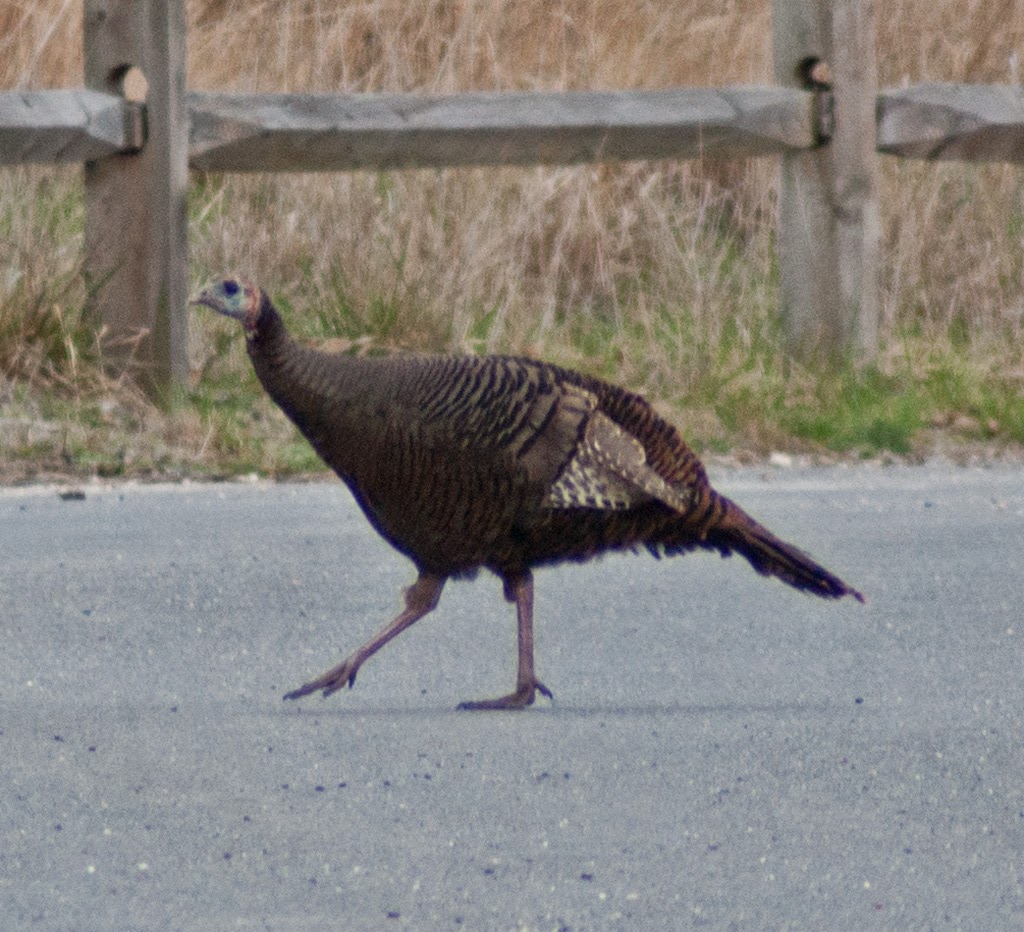
While photographing the Red-tailed Hawk in the parking lot at Forsythe, I turned toward the visitors' center and saw a Wild Turkey heading over to check out the bird feeders for any easily obtained seed that may have been spilled by the smaller songbirds.

Wild Turkey

And this bird had me puzzled for a bit because those that I thought it might be are usually found high in the tops of trees and not near the ground. Checking All About Birds, however, proved I was correct in calling it a female Scarlet Tanager.

Female Scarlet Tanager

One of their photos of the female is in almost the exact pose as mine! (Just scroll down on this page to Field Marks and select either the male Tanager or the Female Tanager. The photo labeled "4 of 6" is the one to which I refer.)

This ends the series of photos from my trip. I saw lots more birds whose photos I either didn't take or whose photos didn't come out quite as expected. In total I had approximately 75 species from Tuesday afternoon through Friday evening without looking for things like owls or rails or nighthawks.

There may have been a few birds I saw that I didn't/couldn't identify. For example, I'm not sure if that was a Chimney swift I saw with the Purple Martins, Barn Swallows and Tree Swallows over the ponds at the Lighthouse, but it sure looked like a flying cigar! And those black and white birds that took off as I topped the dunes at the Lighthouse SP...were they Black Skimmers looking for a nest site? All in all I think I did alright. Certainly the species count was not too shabby, in my opinion.

What I saw on MY Spring Break (Part 6)

Then there were wading birds (besides the egrets). A lot of the shore birds were still to the south awaiting the spawning of the horseshoe crabs, but there were a few that were either year-round residents or just early arrivals.

One morning at Forsythe I found a group of Glossy Ibises feeding in the ditch along side the road.

Glossy Ibis

Glossy Ibis

Glossy Ibis

The mud flats played host to numerous Greater Yellowlegs with their spotted breasts and long yellow legs and bill.

Greater Yellowlegs

Greater Yellowlegs

Greater Yellowlegs

Greater Yellowlegs

The rocks and edges of the flats held several pairs of Oystercatchers.

Oystercatcher

Oystercatcher

As the week went on there were several early arrivals in the form of Dunlin. Whirling flocks of these small birds could be seen on the flats. Their shorter legs and slightly down-curved bills helped to identify them.

Dunlin

One morning at Sunset Beach I saw this small bird hoist itself onto the rock jetty just above the breaking waves. It looked and acted exhausted. Not being in its breeding plumage yet, it puzzled me but based upon its size and short bill, I figured it was a Ruddy Turnstone. It was early to the feast but it will be joined by thousands of its relatives as well as Semi-palmated Plovers in a few weeks...if it lives that long.
Ruddy Turnstone

I did see a half a dozen Willets at Reed's Beach, but it was the one time I left the camera in the Tundra. DOH!