Saturday, September 10, 2016

Canadian Maritimes: Nova Scotia (the northern part) (Part 3)

Louisbourg, over on the east side of Cape Breton, was a French settlement/fort/port that was taken over by the English several times in it's early history. Today it is a reconstruction of the good old French days with costumed interpreters abounding.

The original governor's home which now serves as park headquarters and museum.  
 This was the only real building Terry and I saw when we were here last in 1977. Things have changed since then!

Suttlers' encampment outside the walls.

Officer's quarters and storage facility.
 Officers who often paid for their commission, could make some extra money on the side by importing goods to be sold. Often to the government.


Children playing to the tune of a tin whistle outside a boarding house.
 The custom of hanging linens from the window not only aired the linens, it informed passers by that there were rooms available.

The main street running parallel to and behind the sea wall to the left.

The main gate into the city from the waterfront.
 The red post in the left front of the photo above was where they would lock up miscreants for some good old public shaming--after leading them down the streets with fife and drum announcing their punishment.

The main street leading up from the waterfront.
 Shops and inns lined this thoroughfare. Those offering food would have a fir branch lashed to the door or sign.

Fife and drums practicing.

Clock on the military barracks.

The Major speaks to the folks prepared to watch a military drill

The Sargent crosses the drill field.

Officer passes orders to the Sargent.

Musicians accompany the arrival of the drill squad.

Flintlocks on shoulders the drill commences under the watchful eye of the corporal.

Having fired their flintlocks (eventually), everyone moves up to the cannons.

Instruction to the cannoneers. (Who paid for the privilege.)

The match is lit.

And BOOM!

And everyone marches off.

Inside the military chapel.
 We strolled around the place for a couple of hours before heading back to the campground.

Canadian Maritimes: Nova Scotia (the northern part) (Part 2)

I'm sure I'm getting my days confused so let's just settle on where we went and forget about the when part. Okay?

We drove over to the little town of Iona which is in one of the central islands in the Bras d'Or to visit the Highlands Heritage Center. (Gotta take the ferry to get there. A cable operated ferry to cover all of 100 yards of water.)

The Heritage Center is a living history museum dedicated to telling the story of the highlanders who came to the area.
This stone hut was what they left behind.

The log cabin is what they built first. This one is in need of repair.
They brought some of the old world cattle with them, too.

As well as sheep and draft animals.

Some roof repair being done on the barn.

Churches sprang up.

As the farmers prospered, their homes became more modern.


School, carding mill, country store, and blacksmith shop.
 The teaching of Gaelic was forbidden both here and in the old world, but it continued in the home. Students who spoke or wrote Gaelic at school were shamed by their teachers and had to wear a wooden plank on a rope around their neck.

Carding machines took some of the hand labor out of the home.
 It was an interesting glimpse into the past. A time trip we would continue as we spent the next day at Louisbourg.


Canadian Maritimes: Nova Scotia (the northern part) (Part 1)

After having a wee bit of trouble locating our campground despite it being on the main highway (Mapquest and Siri let me down!), we settled in and set out to explore.

Driving in Cape Breton is like driving in Quebec. Everything has two signs. The difference is, while Quebec has English and French, the signs on Cape Breton are in English and Gaelic! (The French is easier to read!)

We ended up having a scrumptious seafood dinner in the town of Baddeck and then attending a Gaelic get together known as a Ceilidh.

Means "visit"

Lots of Celtic music by a fiddle player and a pianist.


And a little dance lesson, too. (Basically a square dance.)


Canadian Maritimes: Nova Scotia (the southern part) (Part 4)

This day we were going to take the ride north and cross over to Prince Edward Island--until we learned the bridge toll would be $45 Canadian. The ferry is even more, around $75, and requires advance reservations.

So, instead, we drove along the shores of the St. Lawrence toward Antigonish and Pictou. We had missed the Highland's Games at the former by one week but the helpful personnel at the visitors' center were able to find the ever illusive Dunn Clan on their computer. Dunn was my mother's maiden name and, while she always said it was a Scot's name, we were never able to find anything about it. The folks in Antigonish printed out a copy of the clan tartan and told us that the Dunns were affiliated with the Erskines and, somehow connected to Prince Charlie. Interesting.

We continued on to Pictou which was a major landing area for Scottish immigrants in the late 1700s. early 1800s. Thrown off their lands by English landlords who were interested in converting farms to sheep pastures and raising rents, thousands came to Canada and the colonies to the south (think Carolinas).

Stone commemorating the Scottish landing iin 1773.

Replica of the ship they sailed on.

Tight quarters below decks.

A little further up the coast, we visited Cape George and it's lighthouse.


Cape George Lighthouse

View from the lighthouse to the east across the St. George's Bay and the Northumberland Strait.

We again returned to our campground in Truro and began our preparations for departure. Our destination was to be the town of Baddeck along the Bras d' Or on the northern portion of Nova Scotia which is also called Cape Breton.

Friday, September 09, 2016

Canadian Maritimes: Nova Scotia (the southern part) (Part 3)

Time to head south again along the west coast of Nova Scotia (the part along the Bay of Fundy). This time we went down to the port of Digby--a place known for its scallops. And as a haven fro the British Loyalists escaping the colonies after all that nastiness of 1776-1781.

Plaque at Loyalist Park
Fishing boats in the harbor

 A short distance out of Digby it the Prim Lighthouse. A beautiful spot to sit and watch the bay, see the fishing boats and ferries enter and leave the Digby harbor or to enjoy the wildflowers.

Prim Point Lighthouse


Entrance to Digby Harbor
Some of the shelving rocks the lighthouse was built to warn about.


Wind-blown trees along the coast.

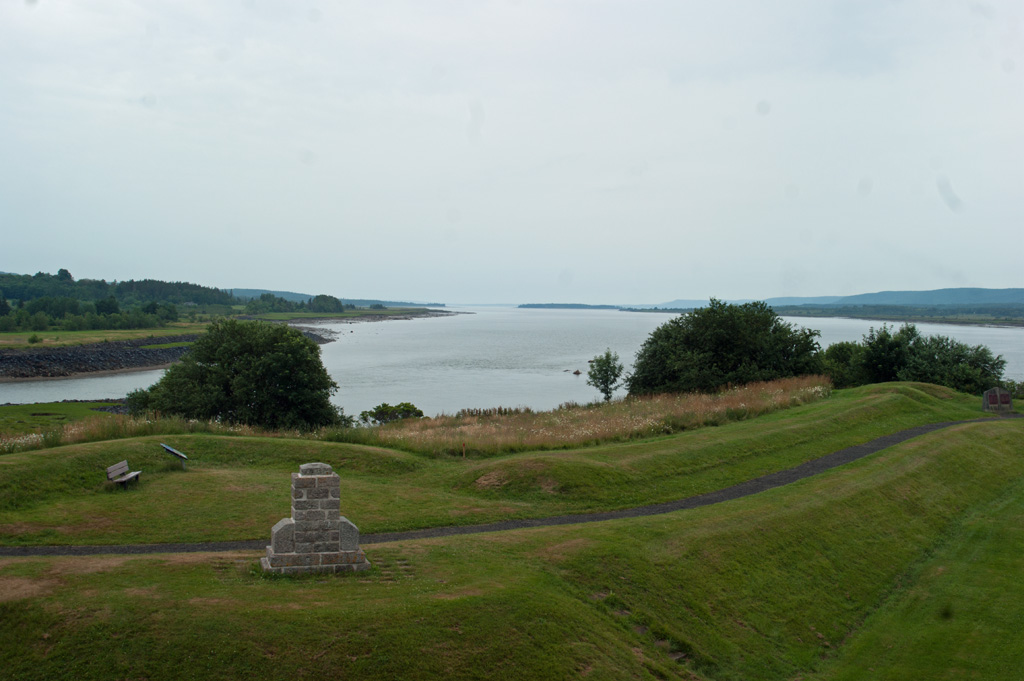
Not far up the coast from Digby is Fort Anne, Canada's first national historic site. It was a French fort built quite a bit before The Citadel. Not a lot of stone used here. It's basically an earthen works fort.


The headquarters was undergoing some renovation.

Storage building made of stone and mortar. It's sunk into the ground to protect it from cannon balls. Looks like they might roll right over it.

Again with the steep sides. Any attacker would be out of breath when/if he reached the top.
Cannon placed on the walls could fire out to the river or sown along the ste\ep slopes of the embankment.


  After Fort Anne we again made our way back to our campground.


Canadian Maritimes: Nova Scotia (the southern part) (Part 2)

Our second day in Nova Scotia we took it easy. We traveled over to the river to watch the tide come in. There were a few other couples there--from Ohio, Iowa and Indiana, I believe. I suggested we have a Big Ten meeting since Terry and I went to Rutgers but now live in PA so we represented 5 of the 12 teams in the Conference.

The tidal bore along the river in Truro is somewhat famous. They've got lights so you can watch it at night and park benches so you can get off your feet while you wait. There's even a small interpretive/information building.

While the total change isn't as great as out in the bay, it's still kind of cool to watch the water flow upstream. We were there during a neap tide period (that's the slowest of the high tide) so we only got to see about a 6-8 inch wave come up the creek.

Waiting on the tide to come in.

Here it comes!

And comes and

comes some more.
It's like watching waves wash up on the beach BUT NEVER GO BACK DOWN. Like shoving 6-8 inch sheets of chocolate covered styrofoam on top of one another over and over again.

Eventually all the brown soil would be covered with water. Amazing.

Then we went back to the camper and did laundry and jumped in the pool.